
Article
Tirana 2026: Field notes from the 8th ECPA Conference
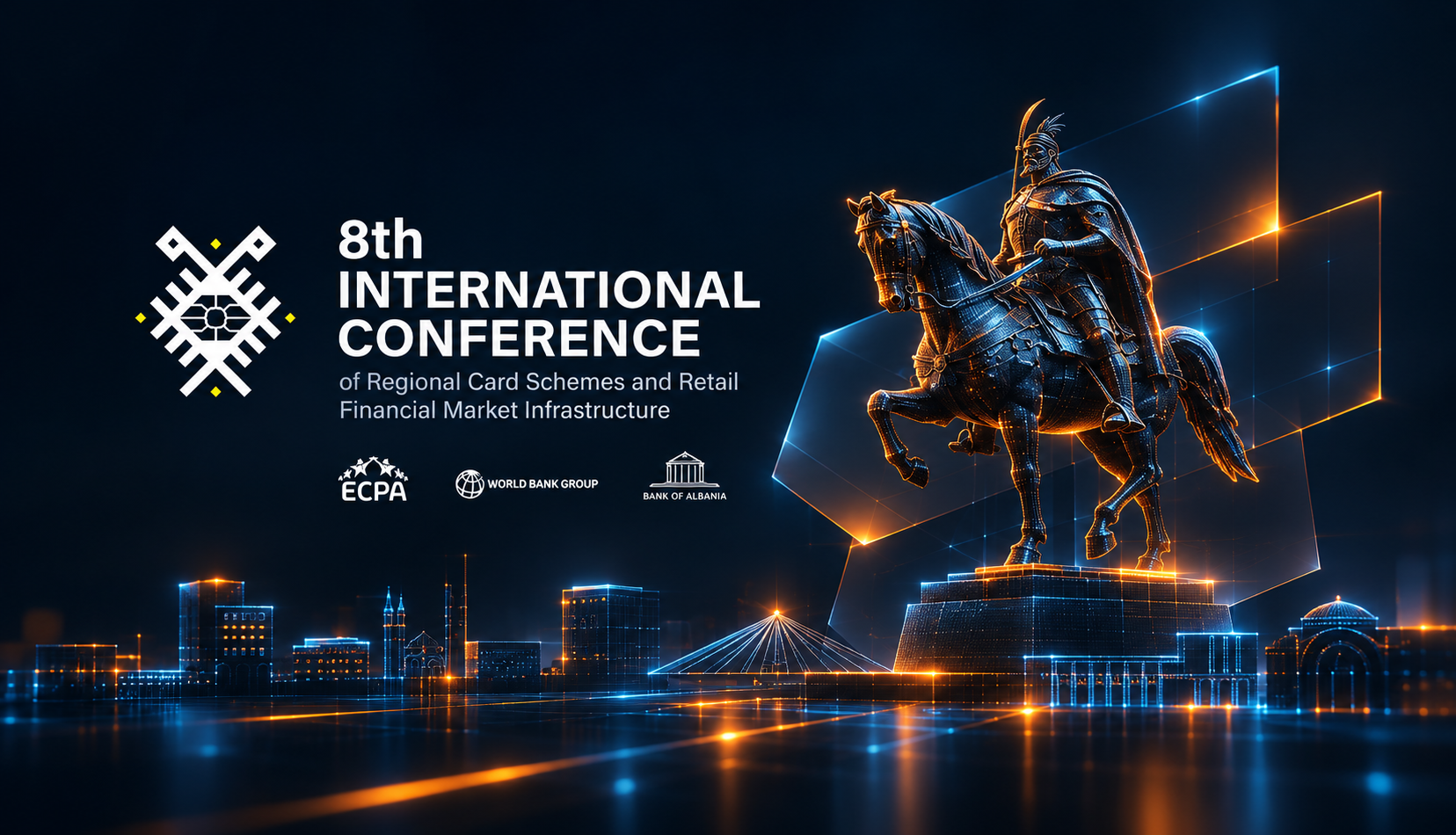
From 3 to 6 November 2026, Tirana brought together one of the year’s most focused gatherings of regional card schemes and payment infrastructures.
Domestic schemes, central banks, infrastructure operators and global networks came together for the 8th ECPA International Conference of Regional Card Schemes and Retail Financial Market Infrastructures, organized by the European Card Payment Association and co-hosted by the World Bank, with the support of the Bank of Albania.
Our Senior Consultant Francesco Chevallard was there. Here are the threads he brought back, and what they mean for the networks we work with.
Domestic schemes are weighing three roads at once
The opening panel put BKM, Cartes Bancaires and Girocard side by side, and the clearest message was that the strategic question remains open. Each scheme is still weighing the same three options:
- Double down on the home market, protecting domestic volume and the economics that come with it.
- Band together with peers, building cross-border reach through a shared initiative, in the spirit of what EPI set out to do with Wero.
- Partner more closely with Visa and Mastercard, trading some independence for global acceptance and scale.
These options pull against each other. A scheme that invests heavily in a regional alliance has less reason to deepen co-badging with the internationals, and a scheme that bets on its home market needs a convincing answer for cross-border and e-commerce. The schemes that make this choice deliberately, and early, will keep the most room to negotiate.
Sovereignty makes the case for Wero, merchants decide its success
The session introducing Wero framed it as a strategic necessity. Europe has not produced a global champion in AI, cloud or the mobile platforms consumers live on, the argument ran, so payments is one of the few domains where it can still build one.
A later panel brought the view from the till. Alongside a representative from Bancomat and an upbeat case for Vipps MobilePay's wallet, a consultant speaking for merchants made a simple point: merchants care very little about where a payment method comes from. They care that it works reliably and that it costs less.
Both things are true, and the gap between them is where European initiatives will be won or lost. Sovereignty secures regulatory support and bank commitment. Merchant adoption still has to be earned on acceptance cost, conversion and operational simplicity, one checkout at a time.
Issuing and acquiring are moving faster than their rulebook
A panel with Robert Kraal (Silverflow), Kjeld Herreman (Paylume), Luigi Paris (Nexi) and Fatbardha Rino (Jet Bank), moderated by Atze Faas of EuroCommerce, gave a practical view of how the business itself is changing. Five points stood out.
Building an acquiring platform has become a serious undertaking. There are more use cases to cover every year and innovation happening at every layer, so for many banks, buying a ready solution is now the faster and smarter route to market.
Everything moves faster now. Something that took years to build a while ago can be done in a few months today. Any roadmap planned on the old timeline is already behind.
Fraud prevention sits at the centre. It came up again and again as one of the industry’s main concerns, and it now shapes product decisions from day one.
Then there’s data. Issuers and acquirers are sitting on enormous amounts of it, and how to actually use it well is one of the biggest questions on the table.
And of course, AI. The benefits are already showing up in how banks and payment companies run internally. Agentic commerce is where it gets trickier. When an agent makes the purchase, who carries the liability? How do we make each step of an Agentic Commerce transaction integrate into the current payment flows?
The common thread is an industry moving faster than its rules. Much of the most interesting work is happening in that gap now.
AI in payments comes down to trust and intent
David Birch took that liability question further in his talk on AI. His main thesis: the hard problems are trust and intent. As software agents start to initiate payments, every party in the chain needs to know two things. Can this agent be trusted to act for this person, and does this payment reflect what the person actually wanted?
For networks, this is familiar ground in new clothing. Authentication, tokenization and dispute rules already exist to answer versions of those questions for humans. The networks that extend those mechanisms to delegated, machine-initiated payments will set the rules others follow.
The Eurosystem agenda reaches well beyond the digital euro
One of the keynotes came from Piero Cipollone, Member of the ECB Executive Board, who leads the digital euro project. The digital euro took its expected place in the speech, and the parts that deserve wider attention sat next to it.
The first is the ECB's dual-track plan for DLT settlement. Pontes is the Eurosystem's own DLT-based solution, linking market DLT platforms to TARGET Services so that tokenised transactions can settle in central bank money, with a pilot scheduled for the third quarter of 2026. Appia is the longer-term roadmap for an integrated, tokenised financial ecosystem in Europe.
The second is closer to home for this audience. Cipollone said in Tirana that the Bank of Italy's instant payment system built on TIPS technology is already operational in Bosnia and Herzegovina and Montenegro, and is coming to Albania, Kosovo and North Macedonia. The Eurosystem is exporting infrastructure, and with it standards. For any scheme active in the Western Balkans, that changes the baseline it competes against.
Malaysia, Ghana and India brought the sharpest thinking
The standout panel of the conference featured representatives from Malaysia, Ghana and India. All three markets have built real-time, account-based payment rails at national scale, and the speakers showed a level of execution and clarity that European incumbents would do well to study.
Central banks are building fast payments as public infrastructure
The central bank governors' sessions shared a common direction. Almost every institution represented is investing in instant payments, for two reasons that reinforce each other. Fast payments give a country strategic control over its own payment flows, and they reach large unbanked populations that card networks have struggled to serve profitably.
The Balkan central banks are taking a particularly pragmatic approach. Individually, their markets are too small to attract the strongest technology providers on favourable terms. By coordinating, they turn several small procurement decisions into one attractive contract, and gain negotiating weight with it.
The same logic, applied across borders, is behind Nexus. Nexus Global Payments is a Singapore-based entity incorporated in 2025 by the central banks of India, Malaysia, the Philippines, Singapore and Thailand to connect their domestic instant payment systems through a single standard link. The BIS notes that the Eurosystem intends to join as a special observer, as part of its work on linking TIPS with other fast payment systems. One connection to reach many countries is a model that card schemes, with their bilateral cross-border arrangements, should take seriously.
Incumbents see CBDCs and stablecoins as one more rail to connect
Some of the most revealing conversations happened away from the stage. Over lunch, a senior executive from one of the established global messaging networks offered a calm view of CBDCs and stablecoins. To him they are simply new payment instruments to integrate, much like every instrument before them.
His confidence rests on reach. No other network connects as many institutions in as many jurisdictions, and he doubted that BRICS countries could build a credible alternative quickly.
That confidence is well founded today. The developments discussed elsewhere in Tirana suggest where it will be tested: shared standards and hub models like Nexus make reach cheaper to assemble, one connection at a time.
What Tirana adds up to
The common thread across the conference was infrastructure moving into public and collective hands. Central banks are building and exporting instant payment rails, regional groups are pooling their bargaining power, and multilateral hubs are turning cross-border reach into a shared utility.
For domestic and regional card schemes, this sharpens the question the opening panel left open. The value of a scheme will rest on what it adds on top of the rail: risk management, dispute resolution, consumer protection, merchant economics and a brand people trust.
The schemes that define that value clearly, and choose their partners accordingly, will shape the next decade of payments in their markets. We look forward to continuing these conversations, and to the 9th edition.